help user manual - implexa v.4
1 | access and user identification
In order to play implexa, you must first access the game's web address. Your teacher will tell you and your classmates which URL to enter in the browser, as well as your username and password.

Next, when your teacher tells you to do so, you must enter your username and password and press the enter button. As soon as you have identified yourself correctly, the game will begin and you will take on the role of a company within the logistics supply chain, for example: a factory that must fulfil orders from end customers, or one of its first-tier suppliers, or perhaps one of the second-tier suppliers, etc.
All the gameplay and the necessary information will appear on a single screen, but before you start playing, keep reading the help section to better understand the user interface and how to play.
2 | getting to know the interface
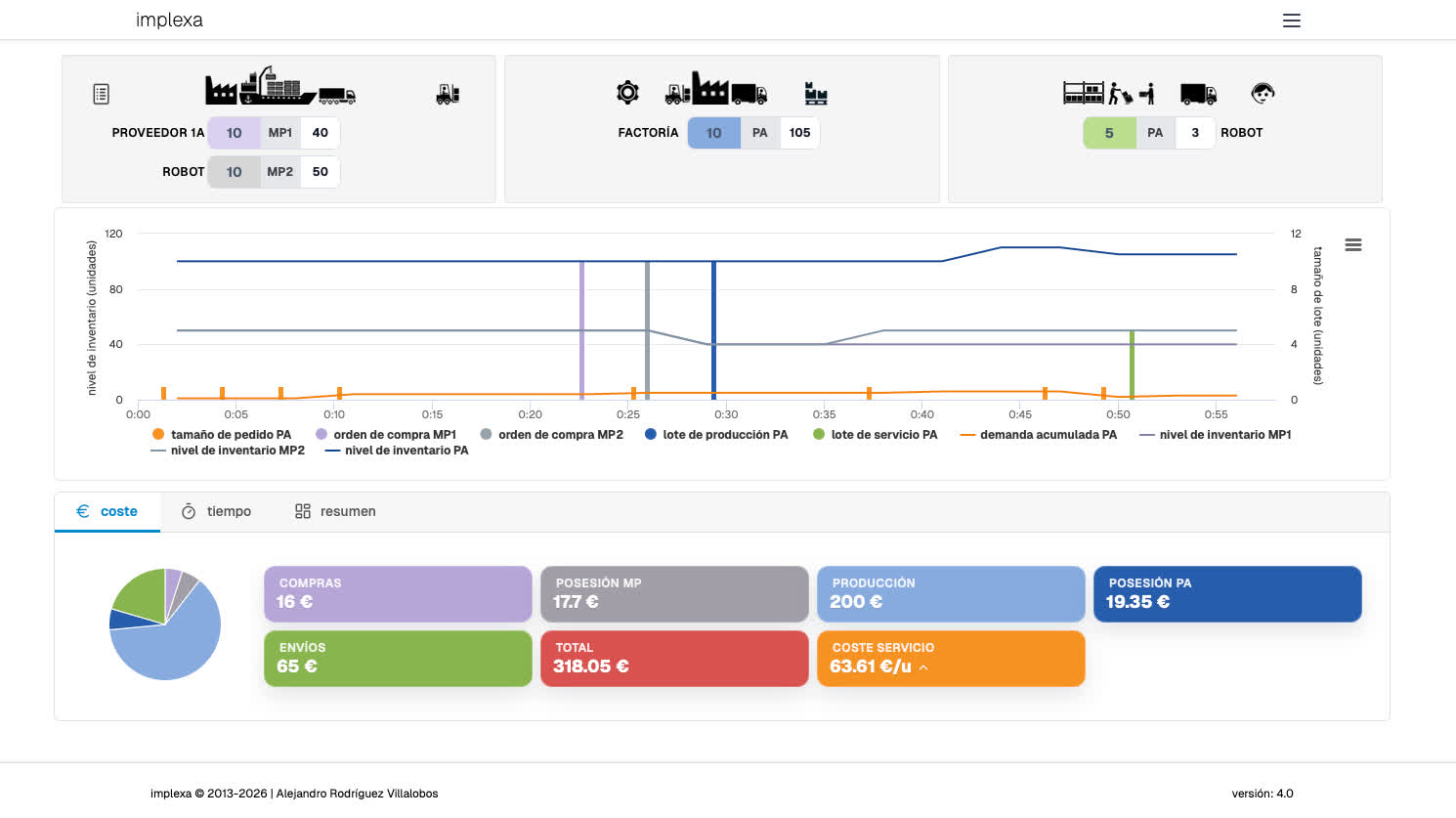
All the information needed to play the game is displayed on a single screen. The interface is divided into three areas (decisions and actions at the top, the control chart in the middle, and the results tabs at the bottom).
- decisions and actions
At the top there is the control panel where you can make your decisions and actions.

Divided into three columns, from left to right you will see:
- your suppliers. In the section on the left you will see your 2 suppliers (one for each raw material RM1 and RM2). If one or both suppliers are identified with the word robot, it means they will be simulated by the system and will not be a human player like you. From this section you can place orders with your two suppliers and see the quantity of each raw material you have in your raw materials warehouse.
- your company. In the central section the name of your company appears. From here you can launch the order to manufacture finished product (FP) from the raw material available in the raw materials warehouse. You need 1 unit of RM1 and 1 unit of RM2 to obtain 1 unit of FP. You will also be able to see the quantity of FP available in the finished product warehouse.
- your customer. From this section you will see the name of your customer. You will be able to send finished product to them whenever they have placed an order and whenever you have finished product available in the finished product warehouse. The number of pending orders to be fulfilled (pending demand) is shown in the box on the right. If your customer is called robot, it means you are the company downstream serving the final market. The demand from that final customer is simulated by the system.
As you can see, each section contains the company name (or Robot if that logistics actor is handled automatically by the device), a coloured cell to select the quantity of items to manage (raw materials or finished product depending on the case), a grey button to execute the corresponding action (buy raw materials, produce, send finished product to the customer), and a white cell that shows the inventory level (raw materials, finished product) or the accumulated demand pending fulfilment (in the case of the customer).
With all this information, you must make decisions about when and how much to buy, produce, store and serve in order to satisfy demand in the shortest time and at the lowest possible cost. You will not be able to produce 1 unit of finished product unless you have at least 1 unit of each type of raw material. And you will not be able to serve 1 unit to your customer if they have not ordered it and if you do not have it in the finished product warehouse. You will also not be able to serve your customer more units than they have ordered, even if you have them available.
Keep in mind that there will be a lapse of time between the moment you make a decision and execute it and the moment the result is obtained. A set of animated icons will represent your level of activity (order placement, information flow and material flow).
- operations control chart
In the central row of the screen, a chart is displayed that updates in real time (horizontal axis) with a set of indicators. On the vertical axis on the left, inventory levels are shown (raw materials and finished product), as well as the accumulated pending demand to be satisfied. On the vertical axis on the right, lot sizes are shown for purchase orders of raw material components, production orders for finished product, and shipment or service orders. The size of the orders arriving from our customer also appears. Note the colour of each data series: these same colours are used in the action buttons and in the result indicators.
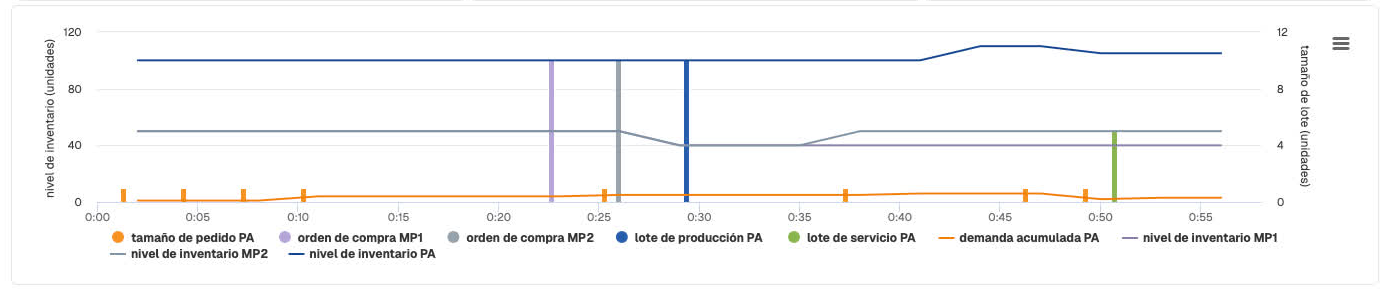
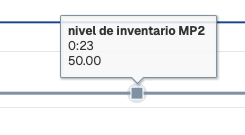
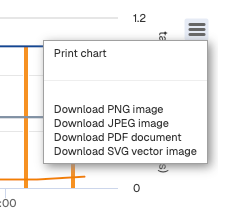
The chart is interactive and has three very useful features: from the legend you can hide/show the series you want by clicking on their names. If you place the mouse over any point on the chart, the detail of the series and its value will appear. From the menu on the right you can print the chart or export it to an image file (in different formats).

- results
At the bottom of the screen you will see three tabs (cost, time and summary), each of which gives you real-time access to the results of the current game.
In the first tab you will see the total accumulated costs and their percentage according to their origin (purchases, production, shipments, and holding cost in the warehouse according to material type). The total overall cost is also calculated, as well as the average cost of each unit served to the customer.

In the time tab, the total time required to make the product available to the customer appears (total lead time). It is calculated from the time you spent on your purchasing, production and shipping operations. The total lead time is the sum of those times and is expressed as the average time in seconds required for each unit managed and served to the customer.

The last tab shows a summary of your activity in the game: total game time, total units (purchased for each raw material, manufactured, ordered by your customer and served), the service level as a percentage of satisfied demand, and the average inventories of each component, finished product and all raw materials.

3 | how to play
Your teacher will explain the general objectives of the game (what your company should try to achieve), and also some rules that you must follow for the game to run correctly (players per team, maximum game time, the information available to you, the information that can or cannot be shared with other teams, etc.). Keep reading to learn in more detail how to play.
- real time
 implexa is a real-time game. It is not a turn-based game, where players' actions and decisions take place in a more orderly sequence, one after another. In implexa everything happens quickly (there is no time to lose) and simultaneously (in a somewhat chaotic way)... just as it happens in the reality of companies. Depending on the teacher's decision, there may be a time scale, that is, one minute of real game time may be equivalent to one working day, one week, etc.
- demand
 There are two types of demand: independent demand comes from the final customer in the market (consumer), and it is subject to its own nature: cyclicality, trend, seasonality and uncertainty. In principle it is unknown, although the teacher may give you some information in different rounds of the game so that you can forecast demand. Dependent demand is the demand for components or raw materials that comes from the requirements of the production plan. You need one unit of each raw material component in order to manufacture one unit of finished product. Therefore, independent demand is translated into dependent demand towards suppliers; in other words, while the company serving the final customer must deal with independent demand, its supplier must deal with its dependent demand.
- costs
 Different types of costs are considered in the game. On the one hand, there are variable costs depending on the quantity of materials managed (raw material purchasing, production, shipping and holding costs). On the other hand, there are fixed costs independent of quantity (purchase order management and release, machine setup and production order release, order preparation and dispatch). Finally, holding costs (warehouse costs) for both raw materials and finished products must also be taken into account. Costs are assigned in real time.
- lead times
 Although the game takes place in real time, the result of your decisions and actions will not be instantaneous. A number of lead times are required for your order to reach your supplier, to start up and manufacture a batch of products, to transport the finished product to the customer, etc. You must keep in mind that these lead times propagate throughout the chain (your supplier will also need time to manufacture and deliver your orders) and will cause a delay in the behaviour of your actions.
- other considerations
 There are other considerations you must keep in mind. In the game there is a limit on production capacity per unit of time. This means that although you can launch a very large production batch, the larger it is, the longer it will take to manufacture and to become fully available in the finished product warehouse. On the other hand, there is no limit on warehouse capacity, so you can store as much as you want. There is also no financial limitation: you will be able to buy and hold as many products as you want. There is no limit on the costs you can incur. The teacher will make you reflect on the outcome of your actions and their possible profitability.